
Citrix Patches NetScaler SAML Zero-Day CVE-2026-88779 After Attacks Reboot Freshly Patched Appliances
Citrix shipped its second emergency NetScaler update in a week after attackers crashed SAML-enabled gateways that had already been patched for the PitScaler flaws, and incident responders say the forced reboots are being used to fire earlier log-injection payloads on appliances that missed the first fix.
Noah Park, ResponseNew York5 min read
NEW YORK - Citrix has released its second round of emergency NetScaler updates in a week, fixing a SAML authentication flaw tracked as CVE-2026-88779 that attackers used to crash and reboot NetScaler ADC and NetScaler Gateway appliances, including appliances administrators had just patched against last month's command-injection bugs. Citrix rates the flaw 8.7 on the CVSS scale and describes it as a memory overflow leading to denial of service. The Cybersecurity and Infrastructure Security Agency added it to its Known Exploited Vulnerabilities catalog on Sunday, October 4, and gave federal civilian agencies until October 7 to mitigate it.
Exposure is narrower than last week's flaws. Citrix's bulletin, CTX697174, says an appliance is affected only if it is configured as a SAML service provider (add authentication samlAction) or a SAML identity provider (add authentication samlIdPProfile). Fixed builds are 14.1-73.41 and 13.1-64.28, with 14.1-73.41 FIPS and 13.1-37.282 for FIPS and NDcPP customers. The catch for teams that moved fast is explicit: "If you upgraded your NetScaler deployment with one of the updated software releases identified in the security bulletin for CVE 2026-88771 through CVE 2026-88778, and if you have determined that your NetScaler deployment meets the preconditions describe above, please upgrade your deployment again," Citrix said.
The attacks surfaced through administrators before an advisory existed. BleepingComputer reported that admins on Reddit described repeated forced reboots on appliances running 14.1-73.37. The nsaaad authentication daemon crashed until Pitboss, the NetScaler process watchdog, hit its restart limit and rebooted the box. One administrator found crafted authentication usernames carrying shell commands that fetched a payload from 213.209.159[.]55, saved it as /v, and ran it, immediately before three crash sequences, while stressing that the logs did not confirm execution. Citrix posted a notice about a "newly observed issue" on Friday, October 2, and shipped fixes early Sunday.
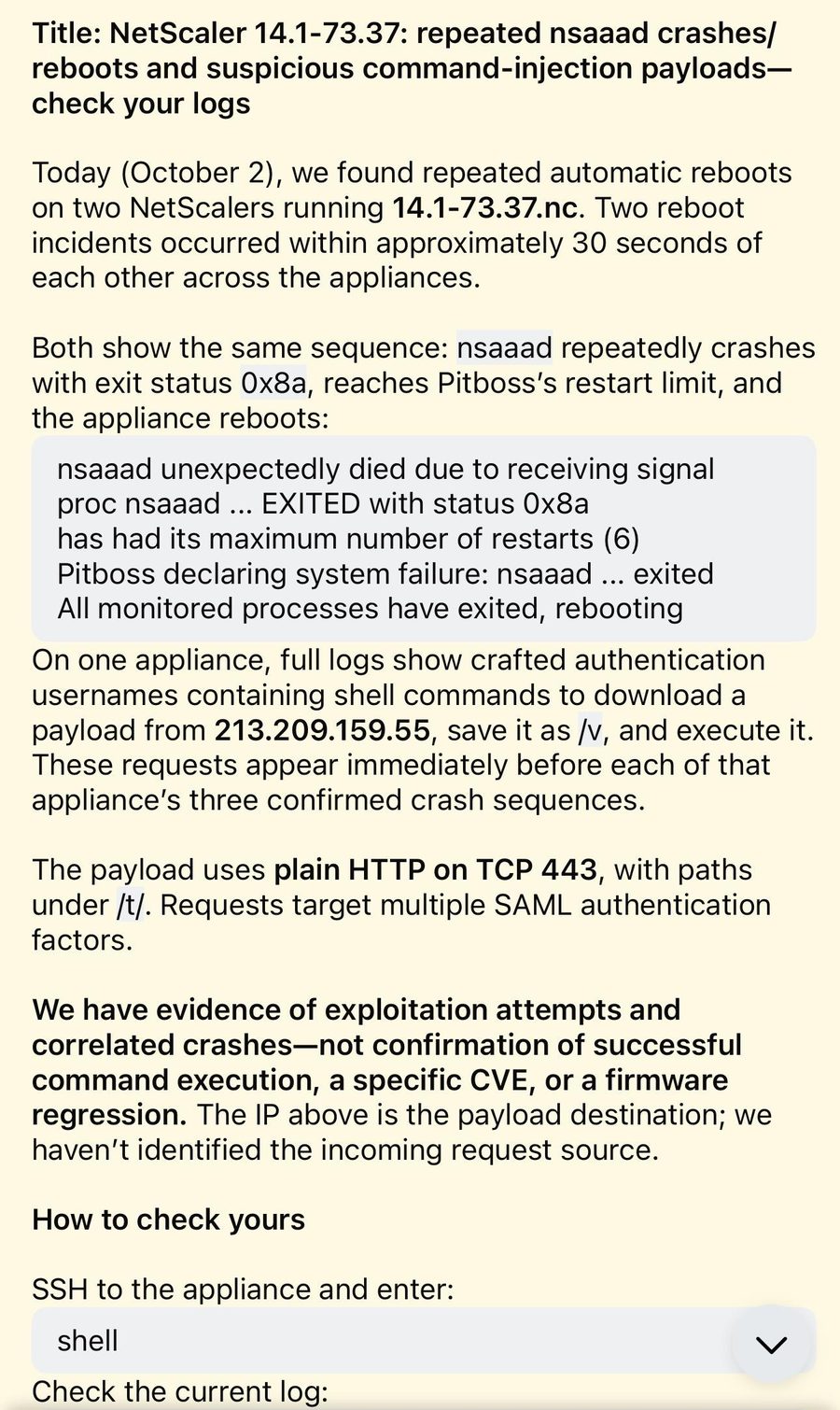
How far the flaw reaches is disputed. Citrix said, "Our analysis indicates that this issue affects service availability, and we have not identified an impact on the integrity of customer data." Researcher Kevin Beaumont, whose patched honeypots crashed, wrote on October 2: "So on one of the honeypots it's running a downloaded (malware) binary. Both were patched, so new vuln." He noted that CVE-2025-6543 carried a similar denial of service label before attacks showed it enabled code execution.
Beazley Security, drawing on its incident response work, offers the most specific account. Its advisory, updated October 4, says the crash occurs while nsaaad processes an oversized InclusiveNamespaces PrefixList in SAML signature canonicalization settings, and that attackers use it to force reboots on appliances already holding an injected pitboss message from the CVE-2026-88771 technique. On unpatched boxes, the root script ns_monuploadd_err.pl reads that message after boot and runs the embedded command. Beazley said appliances patched on September 27 no longer execute those commands and "we have found no evidence of code execution on patched systems." The new bug, in effect, is a trigger that shortens the wait for the old one.

For security operations teams, the work splits into exposure, crash forensics, and compromise checks. Grep ns.conf for samlAction and samlIdPProfile, then upgrade in-scope appliances again. Search /var/log/ns.log and rotated ns.log*.gz files for proc nsaaad with SIGNALED or EXITED, maximum number of restarts, and Pitboss declaring system failure, and check /var/core for nsaaad cores. Hunt logs and firewall records for 213.209.159.55, plain HTTP on TCP 443 to paths under /t/, and the pylrk.cc and pyrlnk.cc domains. In the SIEM, look for authentication lines pairing pitboss with ${IFS}, b64decode, or shell characters, and User-Agent values beginning INDEX: followed by Base64. Before rebooting, check /etc/httpd.conf for php_flag engine on, confirm /bin/sh is not setuid, and snapshot virtual appliances. A missing /v file does not rule out earlier execution.
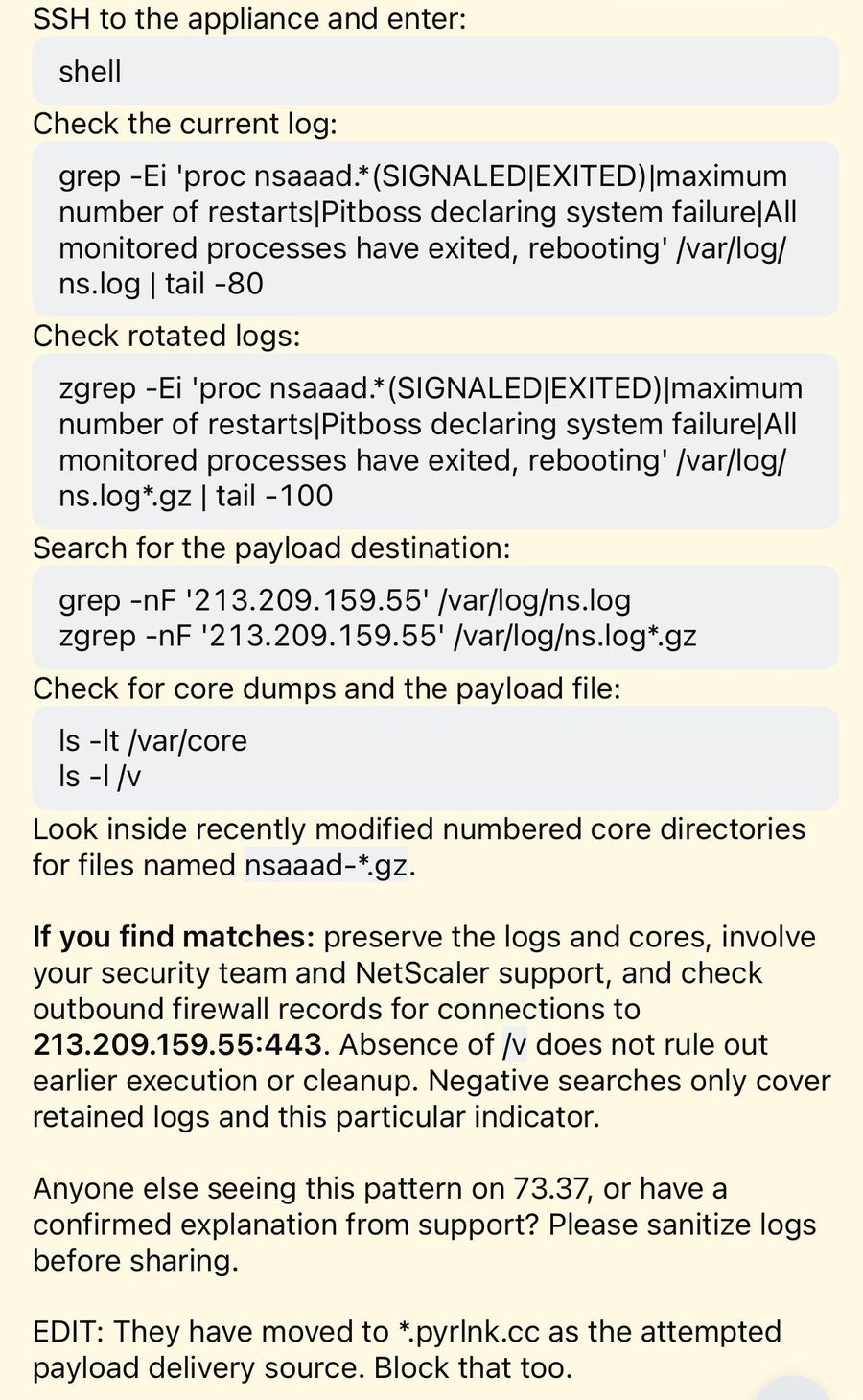
Beazley also noted that patching does not remove backdoors already installed,. On these fleets, an unexplained reboot is an incident lead for the security team, not only a ticket for the network team.
Sources:
- Citrix: Security Bulletin CVE-2026-88779 (CTX697174), Oct 3-4, 2026
- BleepingComputer: Citrix patches NetScaler SAML zero-day exploited in attacks (BleepingComputer, Oct 4, 2026)
- Beazley Security: BSL-A1216 (Beazley Security Labs, updated Oct 4, 2026)
- Mastodon: Kevin Beaumont (Mastodon), Oct 2-4, 2026
- The Hacker News: New NetScaler Zero-Day Exploited in Targeted Attacks (The Hacker News, Oct 4, 2026)
Noah Park covers incident response, containment, and blue-team operations for SOCtember from New York.